|
A Look Into the Federal
World
by Bob
Brooke
To get an in-depth
look into the Federal era world, there’s no better place than the
Homewood Museum on the campus of John Hopkins University. Originally
the family home of the Carroll family, it has been preserved and
curated as a prime example of Federal era design.
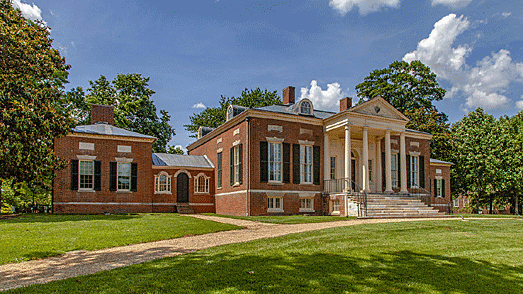
Homewood is one of the best-surviving examples of Federal-period
Palladian architecture in the nation. It began as a wedding gift in 1800
by Charles Carroll of Carrollto, the longest surviving signer of the
Declaration of Independence, to his son Charles Carroll Jr when he
married Harriet Chew of Philadelphia. It occupied 140 acres in northern
Baltimore and was first known as "Merryman's Lott." Though Carroll had
purchased the parcel of land in 1794, Charles Carroll Jr. Didn’t begin
construction on a stately and modern country home of his own design
until 1801.
Meticulously preserved to tell the story of Charles Carroll Jr. and his
family during the early 19th century, Homewood offers an unparalleled
glimpse into the refined tastes and complex societal structures of
post-Revolutionary America in Baltimore. It stands as a testament to the
ambition and style of a prominent Maryland family, built with an eye
toward classical elegance and domestic comfort.
At the turn of the 19th century. America had just secured its
independence, and a new sense of national identity, coupled with
burgeoning prosperity, was taking hold. In Maryland, and particularly in
Baltimore, this era saw the rise of a powerful merchant class and landed
gentry who were keen to display their wealth and cultural
sophistication.
Carroll, Jr., originally intended Homewood as a country retreat from the
hustle and bustle of downtown Baltimore, which, even then, was a growing
port city. The Federal style was explicitly linked to the new American
Republic’s ideals. It drew inspiration from classical Roman and Greek
architecture, evoking a sense of democracy, order, and refinement.
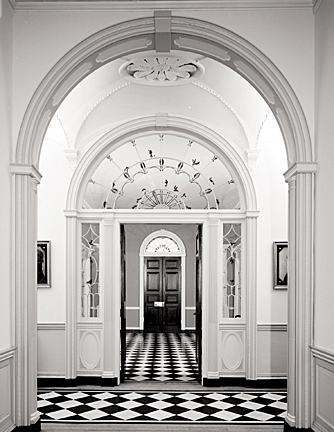 When
visitors enter Homewood, they’re immediately struck by its elegance,
refined symmetry, and an air of quiet sophistication that’s
characteristic of the Federal style. Walking through Homewood is like
stepping into a carefully preserved tableau. Each room tells a part of
the story, revealing insights into the family’s lifestyle, social
customs, and the use of space in a grand Federal-era home. When
visitors enter Homewood, they’re immediately struck by its elegance,
refined symmetry, and an air of quiet sophistication that’s
characteristic of the Federal style. Walking through Homewood is like
stepping into a carefully preserved tableau. Each room tells a part of
the story, revealing insights into the family’s lifestyle, social
customs, and the use of space in a grand Federal-era home.
Upon entering Homewood, visitors are immediately greeted by the central
hall. This isn’t just a passageway. It’s a statement. The spaciousness,
the light, and the elegant staircase immediately set the tone for the
rest of the house. The hall often served as a reception area, a place
where guests would be formally greeted before proceeding into the more
private or social spaces. The staircase, with its delicate balusters and
graceful curve, is a masterpiece of craftsmanship, designed not just for
function but as a central architectural feature.
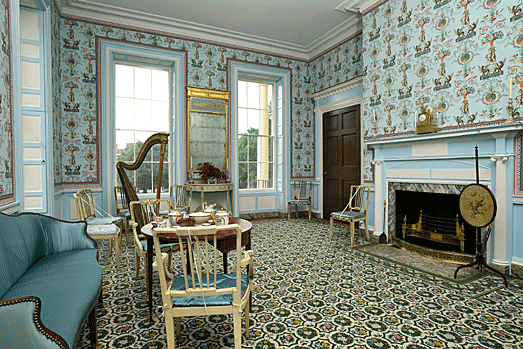
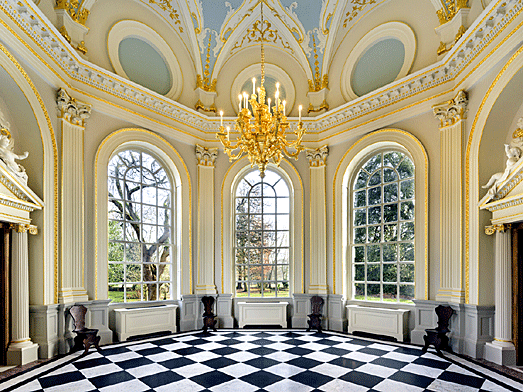
The most celebrated room in Homewood is the octagonal drawing room. Its
unique shape immediately sets it apart, demonstrating the architectural
ingenuity of the period. This room would have been the primary space for
formal entertaining, social calls, and sophisticated conversation. The
light streaming in from its numerous windows, often adorned with
elaborate drapes, would have illuminated the carefully chosen
furnishings, artwork, and, of course, the stunning plasterwork.
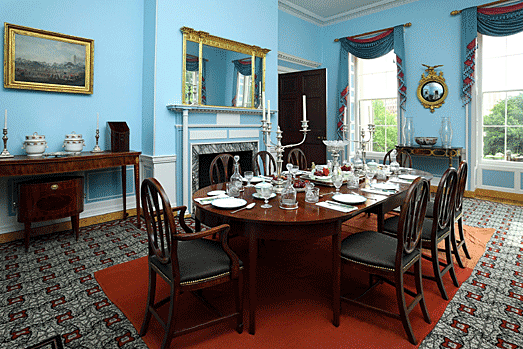
The dining room was crucial. It was where the family shared their daily
meals, but also where they held lavish dinners for guests. The
furniture, the table settings, and the general ambiance all facilitated
gracious entertaining. The decor might have been slightly more robust
than in the drawing room, but still elegant.
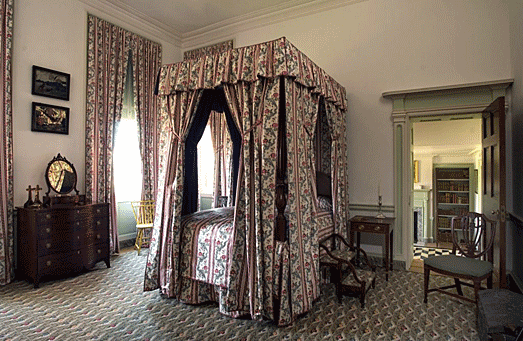
Upstairs, the bedchambers would have been more intimate spaces,
furnished for comfort and personal use. The master bedroom, occupied by
Charles Jr. and Harriet, would have been spacious and well-appointed.
Adjacent rooms would have served as chambers for their children or
perhaps as dressing rooms or studies. While the museum aims to restore
these to their period appearance, it’s in these rooms the day-to-day
routines, the quiet moments, and the personal dramas of the Carroll
family occurred.
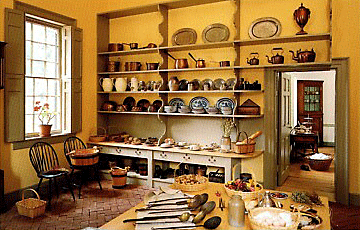 It’s
vital to remember that Homewood, like all estates of its time, relied
heavily on a staff of servants and, tragically, enslaved people to
function. While the main house showcases the Carrolls’ opulence, the
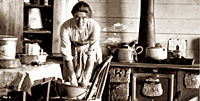
service areas tell a different, often difficult, story. The kitchen,
typically located in the basement or in an adjacent service wing to keep
heat and cooking odors away from the main living spaces, would have been
a bustling, often hot, and strenuous environment. It was equipped with a
large hearth for cooking, preparation tables, and storage. Other utility
spaces, like laundries, cellars, and pantries, were essential to the
household’s operation. These areas, though less glamorous, are integral
to understanding the full picture of life at Homewood, revealing the
complex social hierarchy and the immense labor required to maintain such
a grand lifestyle. It’s
vital to remember that Homewood, like all estates of its time, relied
heavily on a staff of servants and, tragically, enslaved people to
function. While the main house showcases the Carrolls’ opulence, the
service areas tell a different, often difficult, story. The kitchen,
typically located in the basement or in an adjacent service wing to keep
heat and cooking odors away from the main living spaces, would have been
a bustling, often hot, and strenuous environment. It was equipped with a
large hearth for cooking, preparation tables, and storage. Other utility
spaces, like laundries, cellars, and pantries, were essential to the
household’s operation. These areas, though less glamorous, are integral
to understanding the full picture of life at Homewood, revealing the
complex social hierarchy and the immense labor required to maintain such
a grand lifestyle.
 Guided
tours, led by knowledgeable docents, take visitors on a journey through
the house, explaining its architecture, its history, and the lives of
the people who inhabited it. Guided
tours, led by knowledgeable docents, take visitors on a journey through
the house, explaining its architecture, its history, and the lives of
the people who inhabited it.
Homewood Museum also showcases exceptional Federal era plasterwork.
Intricate cornices, ceiling medallions, and decorative friezes featuring
delicate classical motifs such as swags, urns, rosettes, and often
mythological figures graced the principal rooms.
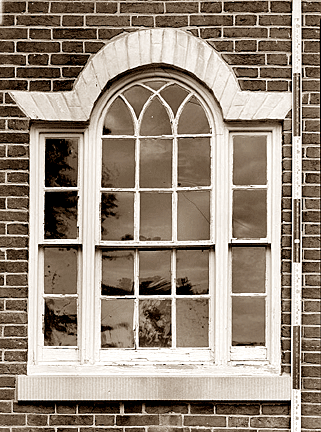
The **Palladian windows** and the grand central portico with its stately
columns and pediment further reinforce this classical inspiration,
connecting the emerging American architectural style directly to the
revered traditions of ancient Greece and Rome. These elements
collectively demonstrate a commitment to both aesthetic beauty and
intellectual ideals, making Homewood a prime, tangible representation of
Federal architecture.
<
Back to More Antiques to View
Next
Article >
|