|
America's First Fine Tableware
by
Bob Brooke
 Prior
to the American Revolution, the colonists, those who could afford it,
imported all their fine tableware from England and France. But after the
war, German immigrant Henry Stiegel changed all that. Prior
to the American Revolution, the colonists, those who could afford it,
imported all their fine tableware from England and France. But after the
war, German immigrant Henry Stiegel changed all that.
Heinrich Wilhelm Stiegel, nicknamed "Baron Stiegel,” was born in
Cologne. Germany, on May 3,1729, the eldest of six children born to John
Frederick and Dorothea Elizabeth Stiegel. He immigrated to the America
in 1750 with his widowed mother and younger brother, Anthony, since his
father and other siblings had died. They arrived in Philadelphia on
August 31, 1750.
After arriving, Stiegel took a job as a clerk with Charles and Alexander
Stedman. In 1752, he moved to Shaefferstown, near Lancaster,
Pennsylvania, where many German immigrants were living. There he got a
job as an ironworker with Jacob Huber at his foundry. Soon after, he
married Huber’s daughter, Elizabeth.
 In
1758, after Huber’s death, Stiegel took over the foundry, rebuilt and
renamed it Elizabeth Furnace, after his wife. He later purchased another
forge that made cast-iron stoves in Berks County called the Tulpehocken
Eisenhammer, which he called Charming Forge. In 1760, he Americanized
his name to Henry William Stiegel. In
1758, after Huber’s death, Stiegel took over the foundry, rebuilt and
renamed it Elizabeth Furnace, after his wife. He later purchased another
forge that made cast-iron stoves in Berks County called the Tulpehocken
Eisenhammer, which he called Charming Forge. In 1760, he Americanized
his name to Henry William Stiegel.
With profits from his iron furnaces, Stiegel established a small
glassworks at Elizabeth Furnace and began producing bottles and window
glass in September,1763. He hired European glassblowers, including some
from Venice and paid for their transportation to Pennsylvania.
 Although
Stiegel wasn’t a practical glassmaker, he was very successful in
emulating the various types of English glass in demand in America at the
time, as well as the common engraved and enameled Germanic wares with
which his fellow Pennsylvania Germans had been familiar in their
homeland. With a few exceptions, it’s impossible to distinguish between
products which may have been made in one of his glasshouses and those
produced in England or on the Continent during this time. Although
Stiegel wasn’t a practical glassmaker, he was very successful in
emulating the various types of English glass in demand in America at the
time, as well as the common engraved and enameled Germanic wares with
which his fellow Pennsylvania Germans had been familiar in their
homeland. With a few exceptions, it’s impossible to distinguish between
products which may have been made in one of his glasshouses and those
produced in England or on the Continent during this time.
Stiegel also imported glass-blowers and enamelers from Germany and
glass-blowers from the Bristol, England. Because he closely controlled
the output of his workmen, the products from Stiegel's factories were
far less individual in character than other glassmakers. He employed
pattern-molding as a decorative technique in his glasshouses.
 Nearly
two years later he started another glass factory in Mannheim. Operations
had barely started when the pre-Revolutionary depression imposed
formidable obstacles. Blinded to the ominous signs of the times by his
enthusiasm for his new enterprises, Stiegel pushed ahead heedlessly. The
capacity of the first glasshouse didn’t satisfy him, so he built a
second, larger one, and added to his staff the most expert workers he
could find from England and the Continent. Late in 1769 or early in 1770
the second glasshouse went into operation, and it was here that he
produced most of his finest pieces. Nearly
two years later he started another glass factory in Mannheim. Operations
had barely started when the pre-Revolutionary depression imposed
formidable obstacles. Blinded to the ominous signs of the times by his
enthusiasm for his new enterprises, Stiegel pushed ahead heedlessly. The
capacity of the first glasshouse didn’t satisfy him, so he built a
second, larger one, and added to his staff the most expert workers he
could find from England and the Continent. Late in 1769 or early in 1770
the second glasshouse went into operation, and it was here that he
produced most of his finest pieces.
Stiegel began building a third glass factory, also located in Mannheim,
in 1768, which he completed in 1769. Stiegel's advertisements referred
to the firm as the American Flint Glass Manufactory. Here he produced
colorless and colored flint glass and fine tableware of many varieties,
including engraved and enameled glasses. This was the first glasshouse
in America to specialize in the production of tableware, which emulated
both English and Continental pieces.
This factory was the first to make lead glass in America. The lead glass
of this time, commonly known as crystal because it was colorless and
transparent, was typically used for fine tableware. Stiegel had retail
outlets for his glass at various locations in the Colonies. However, he
expanded too fast and ended production in 1774.
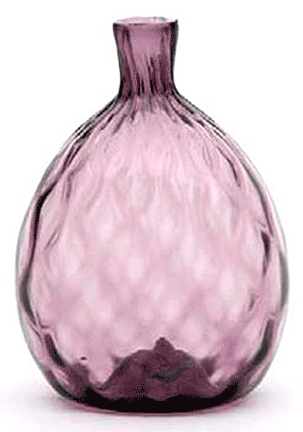
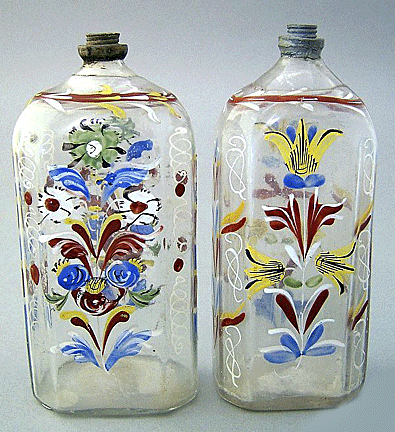 Though
many of his pattern-molded glasses cannot be distinguished from their
counterparts in England or Europe, pocket-bottles, which were once found
largely in Pennsylvania bearing a diamond daisy or a daisy in hexagonal
pattern, appear to have no European counterparts or prototypes. They
were probably made in his second Mannheim factory between 1769 and 1774.
With these exceptions, it’s impossible to distinguish Stiegel's
products, but it’s known from his advertisements and his account books
that his factories produced a wide range of tableware and other glass. Though
many of his pattern-molded glasses cannot be distinguished from their
counterparts in England or Europe, pocket-bottles, which were once found
largely in Pennsylvania bearing a diamond daisy or a daisy in hexagonal
pattern, appear to have no European counterparts or prototypes. They
were probably made in his second Mannheim factory between 1769 and 1774.
With these exceptions, it’s impossible to distinguish Stiegel's
products, but it’s known from his advertisements and his account books
that his factories produced a wide range of tableware and other glass.
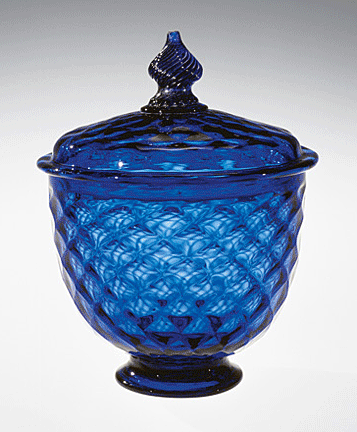
Some of Stiegel’s products included quart molded decanters, pint and
half pint decanters, quart, pint, half pint and gill and half gill
tumblers, wine and water glasses, wine and beer glasses, quart, pint and
half pint mugs, bowls, specie bottles, half pint cans, cream jugs,
smelling salts bottles, vinegar cuets, sugar boxes with covers, chain
salts, mustard pots, pocket bottles, jelly, sillabub and free mason
glasses, phials of all ports, candlesticks, fine wine glasses, common
tail wine glasses, and toys of all sorts. The chain salts, sugar boxes
with covers, and cream jugs were exactly the same as their English glass
counterparts.
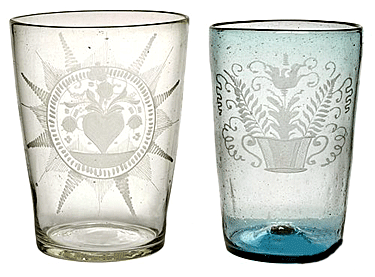
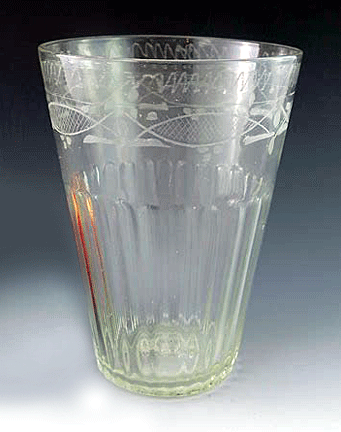
Some of the tumblers and mugs produced were sketchily engraved with
floral and geometric designs in what’s referred to today as peasant or
folk motifs. Because such glasses were widely produced in Europe, those
made by Stiegel are referred to as “Stiegel-type” glasses rather than
Stiegel glasses, because of the uncertainty of their origin.
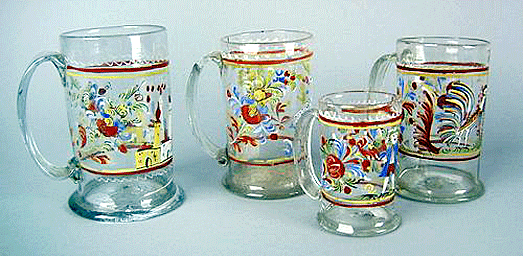
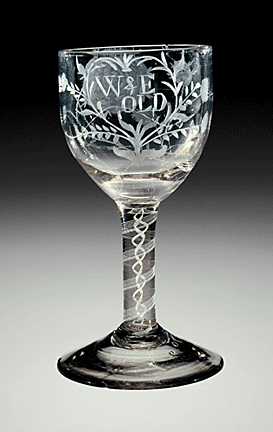
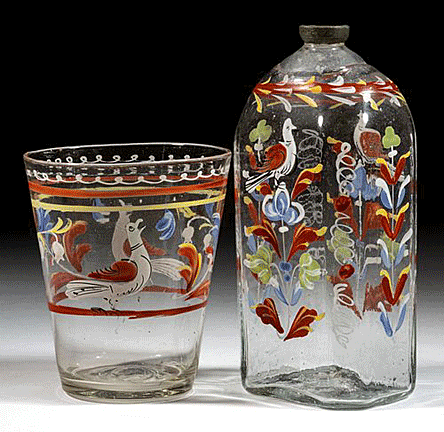 The
same can be said for enameled glasses which Stiegel began
producing in 1772, undoubtedly to supply the local Pennsylvania German
market. They closely imitated the same type of enameled peasant glass
with which these people had been familiar in Germany. About a dozen
enameled tumblers bearing English inscriptions with a Germanic flavor
exist. The tumblers express sentiments, such as : `We Two will he True',
and `My Love you like me do. While these glasses, too, may have been
made in Europe for the American market, they’re likely to have been
enameled in Stiegel's factory. The
same can be said for enameled glasses which Stiegel began
producing in 1772, undoubtedly to supply the local Pennsylvania German
market. They closely imitated the same type of enameled peasant glass
with which these people had been familiar in Germany. About a dozen
enameled tumblers bearing English inscriptions with a Germanic flavor
exist. The tumblers express sentiments, such as : `We Two will he True',
and `My Love you like me do. While these glasses, too, may have been
made in Europe for the American market, they’re likely to have been
enameled in Stiegel's factory.
 Unfortunately
Stiegel’s contemporaries judged him a failure and an object of scorn.
But his failure was his crowning success. Unless he had kept on in the
face of all obstacles, he would probably never have produced his best
glass. Unfortunately
Stiegel’s contemporaries judged him a failure and an object of scorn.
But his failure was his crowning success. Unless he had kept on in the
face of all obstacles, he would probably never have produced his best
glass.
At the time of his business’ failure on May 5, 1774, Stiegel listed
unsold glass with dealers or agents in York, Hanover and Carlisle, as
well as Mannheim in Pennsylvania, Hagerstown, Fredericktown and
Baltimore in Maryland, and New York City. He probably also sent some
glass to the West Indies. A judge ordered the bankrupt Stiegel to
debtors' prison in the autumn of 1774, but he gained release by
Christmas. He died at Charming Forge on January 10,1785.
<
Back to Collectibles Archives
Next Article >
|