Displaying Collectibles for That Wow
Factor
by Bob Brooke
Today, many more people
collect collectibles than antiques, mostly because the former are more
affordable and in many cases take up less space. While many love to
collect these memorable objects from advertising, events, and
promotions, most collectors put far more energy into collecting than
into displaying their collections.

Nine out of ten collectors use shelves to display their treasures. And
while these many serve to group items, they don’t often display them to
their best advantage. A special collectible can get lost in a group—the
old “can’t see the forest for the trees” idea.
 It’s
a good idea take a cue from window and store display decorators. They
stage items so that they’re presented in the best way and will attract
attention from customers. Using some of their methods will elevate an
average collection to something very special. The secret is in the
staging. It’s
a good idea take a cue from window and store display decorators. They
stage items so that they’re presented in the best way and will attract
attention from customers. Using some of their methods will elevate an
average collection to something very special. The secret is in the
staging.
When there’s more items than space to display them, it’s a good idea to
rotate the collection. Pack up some of the items and store them for a
while and display the rest. You change out these items for those on
display every six months or so. Or you can group them into small
“exhibits” on a theme.
If there are several items that are really special, display them alone
in different rooms as a focal point or a conversation piece. Create
different displays in different rooms.
But just displaying an item by itself isn’t enough. You need to add
focus with lighting. There are all sorts of small high-intensity lamps
to use, many of them battery operated. The new LED ones are especially
good. Push button LEDs add just the right about of light. Test with a
flashlight, shining it from each direction to get an idea of which way
the light best serves the object. Shadows cast from the object can add
to or subtract from its beauty, so evaluate your lighting well.
 Store
and window display designers are very careful about the backgrounds they
use. A busy background can interfere with a display. Busy wallpaper, for
example, can distract a viewer’s attention from the object to be
highlighted. Most often, a soft, solid color serves best as a
background, though a bold color is in order if an object is pale.
Contrast between the object and the background is important. Store
and window display designers are very careful about the backgrounds they
use. A busy background can interfere with a display. Busy wallpaper, for
example, can distract a viewer’s attention from the object to be
highlighted. Most often, a soft, solid color serves best as a
background, though a bold color is in order if an object is pale.
Contrast between the object and the background is important.
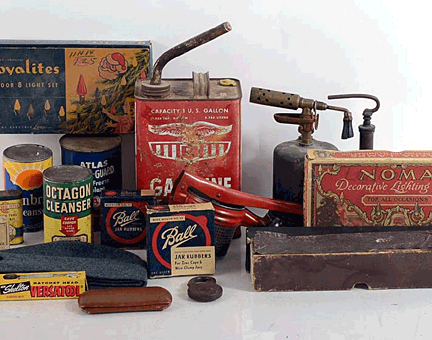
With mundane or more common objects, staging is all important. Place
mundane objects in a stage-type setting. The stage itself could be a
pedestal for one object or shelves for several objects. The most exotic
the stage, the more attention the objects will get.
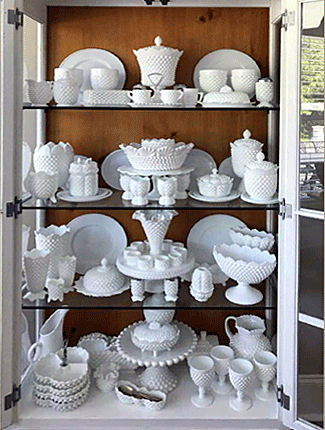
Display valuable collectibles behind glass. This could be a glass
cabinet with multiple shelves or perhaps a single small cabinet for one
special piece. To avoid having to frequently dust small collectibles,
place them in multiple-shelf cabinets with glass doors.
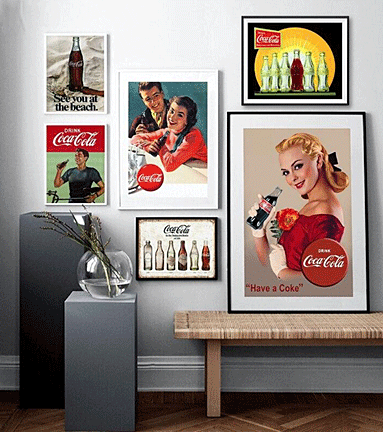 t’s
best to hang paper collectibles like posters in frames with glass or
plexiglass. This keeps them flat and safe from insect pests and such.
Create a gallery wall for optimal impact. This is particularly effective
in a high-traffic area such as a hallway or stairwell. t’s
best to hang paper collectibles like posters in frames with glass or
plexiglass. This keeps them flat and safe from insect pests and such.
Create a gallery wall for optimal impact. This is particularly effective
in a high-traffic area such as a hallway or stairwell.
While ordinary shelves will do, displaying collectibles in unique
vessels will add some pizzazz to a collection. Old dressers are great
for displaying plates and other ceramics, as are old china closets. Try
to find a display vessel that complements the collection, perhaps from
the same time period.
Place collectible items in a room that complements them. Kitchen related
items in a kitchen or bathroom related items in a bath. Remember to
select only those items that can withstand the heat and humidity—and in
the kitchen’s case, grease—and can be easily cleaned.
How a collectible collection is displayed vastly increases its eye
appeal. Think ahead and plan wisely for the best results.
<
Back to Caring for Your Collections
Archives
Next Article >
|