Although roller organs came in different sizes
and degrees of luxury, the most popular one was the "Gem"
Roller Organ, manufactured by a number of companies, including the
Autophone Company of Ithaca, New York.
Originally, these hand-cranked organs operated
by air pressure from exposed bellows, As technology improved, later
models worked by vacuum pressure, thus enabling manufacturers to reduce
the size of the units, much as today’s technology has reduced the size
of radios and cassette tape players.
Because of its relative simplicity,
manufacturers produced tens of thousands annually, thereby keeping the
cost of a roller organ affordable. Sears & Roebuck, in their 1902
Catalog, was able to offer the Gem Roller Organ for as low as $3.25,
including three rollers. Contracting with companies to produce large
quantities of these devices enabled Sears to sell in volume and keep its
price low.
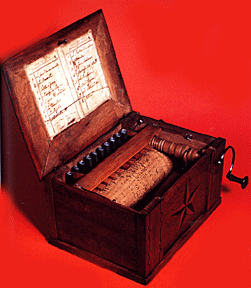
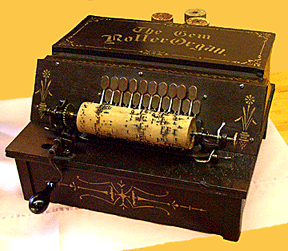 The Gem Roller Organ, available in either a
painted black or walnut-like finish with gold stenciled applied designs,
used teeth or pins embedded into a 20-note wooden roller, similar to the
cylinders used in Swiss music boxes. Pins operated on valve keys while a
gear turned the roller. Priced as low as 18 cents each–and according
to the Sears Catalog, less than traditional sheet music–roller music
ranged from classical to sacred to ethnic and popular tunes. The tone
was similar to a cabinet parlor organ of the time.
The Gem Roller Organ, available in either a
painted black or walnut-like finish with gold stenciled applied designs,
used teeth or pins embedded into a 20-note wooden roller, similar to the
cylinders used in Swiss music boxes. Pins operated on valve keys while a
gear turned the roller. Priced as low as 18 cents each–and according
to the Sears Catalog, less than traditional sheet music–roller music
ranged from classical to sacred to ethnic and popular tunes. The tone
was similar to a cabinet parlor organ of the time.
At 16 inches long, 14 inches wide and 9 inches
high, the Gem Roller Organ was small and light enough to place on a
parlor table. The 1902 Sears Catalog listed 220 different rollers of the
over 1,200 different titles available.
To understand just how much the value of the
Gem Roller Organ has appreciated, Sherrill and Barb Edwards of West
Grove, PA recently priced one at $850 at an antique show in
Pennsylvania.


























 By
the late19th Century, working and middle class Victorians, with more
free time on their hands, sought out ingenious, yet affordable modes of
home entertainment. One such home entertainment device was the roller
organ, a type of table-top music box that played wooden rollers called
cobs because they resembled an eaten cob of corn.
By
the late19th Century, working and middle class Victorians, with more
free time on their hands, sought out ingenious, yet affordable modes of
home entertainment. One such home entertainment device was the roller
organ, a type of table-top music box that played wooden rollers called
cobs because they resembled an eaten cob of corn.