|
Glossary of Arts & Crafts Terms
Page
2
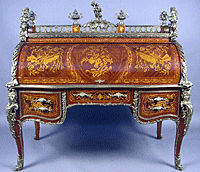
marquetry The use of veneer and often other inlays
to make decorative patterns in wood.
mortise A hole designed to receive a corresponding tenon, so that
the two are held together.
openwork A pierced decoration.
parcel gilding Gilding that only partially covers a metal or ceramic
surface.
pewter An alloy of tin or lead (and usually a variety of other
metals), used for utilitarian domestic ware.
piercing An intricate cut decoration, originally done with a sharp
chisel, later with a fretsaw, and finally with mechanical punches.
portiere A hanging curtain placed over a door or doorless entrance
to a room, from porte, the French word for door.
puce A purple red color formed from manganese oxide, which was used
on ceramics.
quarter-sawn Quarter sawing is a type of cut in the rip-sawing of
logs into lumber, resulting in pieces that are quartered and radially-sawn.
quatrefoil A shape or design incorporating four foils or lobes.
rail The horizontal splats of a chair back.
reeding A decoration created by narrow, convex moldings in parallel
strips and divided by grooves.
repousse ("pushed out") A term for embossing. More precisely, the
secondary process of chasing metal that has been embossed to refine
the design.
roundel A round, flat ornament.
runner A name given to long, narrow rugs, generally c2.6m (8ft 6in)
long by c1m (3ft 3in) wide.
seams The visible joins in metalwork that has been cast in several
places.
settle An early form of seating designed for two or more people.
shoe The projecting piece rising from the rail back of a chair seat
into which the base of the splat is fixed.
splat The central upright in a chair back, loosely applied to mean
all members in a chair back.
solder The lead applied to repair cracks and holes in silver.
spade foot The tapering foot of square section.
standard The required amount of pure silver in an alloy.
sterling silver The British term for silver that is at least 92.5
per cent pure.
stiles The back uprights on a chair and other pieces of furniture.
strapwork The decorative ornament resembling a series of thongs,
rings, and buckles, used mainly in the 16th and 17th centuries and
revived in the 19th century.
stretcher The rail joining and stabilizing the legs of a chair or
table.
tapestry A western European flat-woven textile.
tenons A projecting piece of wood made for insertion into a mortise
in another piece of wood.
trefoil A decorative motif shaped like clover, with three pronounced
lobes.
tube lining A type of ceramic decoration in which thin trails of
slip are applied as outlines to areas of colored glaze.
turning A type of process by which a solid piece of wood is modeled
by turning on a lathe.
veneer A thin slice of expensive and often exotic timber applied to
an inexpensive secondary timber (carcass) using glue.
warp A foundation material running the length of a carpet. Before
weaving can begin, warps needto be correctly positioned on the loom.
The warp is generally made from silk, cotton, or wool.
weft The horizontal threads in the foundation of a rug that are
interwoven with the warps. In most flatweaves, the visible surface
of the rug is composed of weft threads.
x-frame The crossed and interlocking cross-stretchers found on
chairs by Gustav Stickley.
< Back to Glossaries
Next Glossary >
|