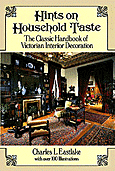
This book was the primary authority on what was
proper, beautiful, efficient in all aspects of mid-19th-century
interior design. Originally published in 1868. Over 100
illustrations. More Books
Mark Twain
is one of only a few All-American writers. Unlike many
contemporary writers and those who followed him, he
wrote for the common man. He traveled and wrote about
places he visited with a sense of humor. In his books
and other writings, he illustrated Victorian life in
both fact and fiction. To learn more, read “Mark
Twain’s America.”
Platters Fit for a Turkey
QUESTION:
For
my family, Thanksgiving was the biggest gathering of the year. I
remember my mother planning the event as early as October. Back in
the 1950s, we'd pile into the car and drive to the local turkey farm
to order a very large bird. My mother would have never considered
buying a frozen turkeys at the local market. I heard her speaking on
the phone to my grandmother about how many were corning, what kinds
of pies should be baked, or whether we would add some new recipe for
cranberry sauce. At the center of it all lay the traditional turkey
platter, which had been handed down for generations. Can you tell me
how these platters came to be, who made them, and why they became so
popular?
Many
families still use a large turkey platter. Though large but not
very sophisticated, it often features a 22-inch pattern with
yellow roses manufactured by Homer Laughlin. It’s got high sides
and can hold a very large turkey, and by now it’s even got a few
rim chips, but it’s part of the family, so it means a lot.
The turkey was the last dish to be brought to the table and the
senior member of the family would always carve the bird.
Everyone would say grace and eat more than any thought humanly
possible. While sitting around the table, family members would
tell stories—Grandpa always seemed to tell the same ones to the
embarassment of his wife. In many cases, this holiday feast was
just as Norman Rockwell painted it.
The First Turkey Platters The
first turkey platters appeared in the early 1870s, when East
Liverpool, Ohio, was the setting for the founding of several
important American potteries due to the existence of raw
materials such as clay, coal and natural gas. One of the largest
and most successful, was the Homer Laughlin China Company,
founded by brothers Homer and Shakespeare Laughlin in 1897. It
went on to become one of the world's major producers of
institutional china, including Fiesta ware. They based their
holiday platters on several of their most popular dinnerware
lines and decorated them with colorful printed transfers.
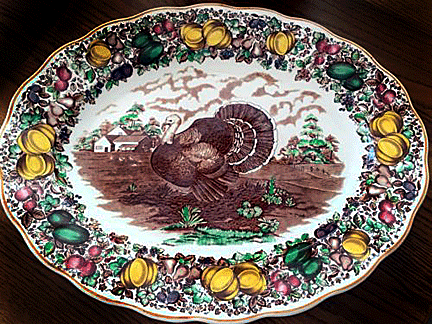
Thus, the same image often
appeared on many of their turkey platters—a bird with its tail
feathers fanned out fully, set against a rural farmyard
background. The platters featured wide rims in Harlequin yellow
and turquoise blue.
In the mid-1950s, a similar design appeared on Thanksgiving
platters made by Taylor, Smith & Taylor, which the company sold
to retailers to use as an advertising premium.
In
its "Historical America" series, Laughlin also produced an
elaborate scene from 1621 called "The First Thanksgiving,"
transfer printed in rose pink and sold exclusively through F.W.
Woolworth. The company also produced a similar "Bountiful
Harvest" platter showing Pilgrims and Indians gathering and
sharing food.
A somewhat scrawnier bird appears on platters and plates made by
Southern Potteries Inc., a Tennessee firm formerly known as
Clinchfield Potteries. It began in 1917 by producing commercial,
semi-vitreous china tableware decorated with stock transfers.
Its better-known trademark, Blue Ridge, debuted in 1932. By the
late 1930s, it had switched from transfers to underglazed
hand-painted decoration. Within 15 years, it had become the
largest American producer of hand-painted china, with an annual
production of 24 million pieces. Some of the firm’s top artists
signed a limited number of special designs, and these are among
the most coveted pieces for collectors.
For
example, there’s a wild turkey platter painted and signed by
artist Mildred L. Broyles, depicting a standing, long-necked
bird eyeing a bug, valued at over $2,000. Another, signed by
Louise Gwinn called “Turkey Gobbler,” shows a bird in a woods
and sells for over $1,750.
While Homer Laughlin and Southern Potteries dominated the
market, there were several other companies, from California and
elsewhere; that staked their own claims. Among these are
platters produced by the Nelson McCoy Pottery Company of
Roseville, Ohio, featuring a solid brown embossed relief of Tom
Turkey, the Delano Studios of Long Island, featuring a soaring
bird in flight, and the Hadley of Louisville platter, with its
whimsical, schematic turkey in blue on vitrified stoneware.
No antiques or collectibles
are sold on this site.
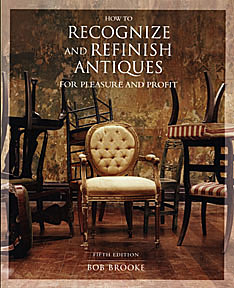
How to Recognize and
Refinish Antiques for Pleasure and Profit
Have
you ever bought an antique or collectible that was less than perfect and
needed some TLC? Bob's new book offers tips and step-by- step
instructions for simple maintenance and restoration of common antiques.
Read an
Excerpt
Auction News
Get up to the minute news of antiques auctions
around the country and the world.

























 For
my family, Thanksgiving was the biggest gathering of the year. I
remember my mother planning the event as early as October. Back in
the 1950s, we'd pile into the car and drive to the local turkey farm
to order a very large bird. My mother would have never considered
buying a frozen turkeys at the local market. I heard her speaking on
the phone to my grandmother about how many were corning, what kinds
of pies should be baked, or whether we would add some new recipe for
cranberry sauce. At the center of it all lay the traditional turkey
platter, which had been handed down for generations. Can you tell me
how these platters came to be, who made them, and why they became so
popular?
For
my family, Thanksgiving was the biggest gathering of the year. I
remember my mother planning the event as early as October. Back in
the 1950s, we'd pile into the car and drive to the local turkey farm
to order a very large bird. My mother would have never considered
buying a frozen turkeys at the local market. I heard her speaking on
the phone to my grandmother about how many were corning, what kinds
of pies should be baked, or whether we would add some new recipe for
cranberry sauce. At the center of it all lay the traditional turkey
platter, which had been handed down for generations. Can you tell me
how these platters came to be, who made them, and why they became so
popular?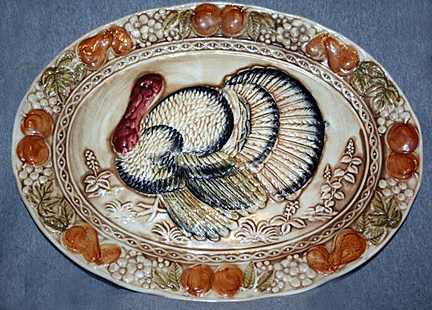 Many
families still use a large turkey platter. Though large but not
very sophisticated, it often features a 22-inch pattern with
yellow roses manufactured by Homer Laughlin. It’s got high sides
and can hold a very large turkey, and by now it’s even got a few
rim chips, but it’s part of the family, so it means a lot.
Many
families still use a large turkey platter. Though large but not
very sophisticated, it often features a 22-inch pattern with
yellow roses manufactured by Homer Laughlin. It’s got high sides
and can hold a very large turkey, and by now it’s even got a few
rim chips, but it’s part of the family, so it means a lot.  The
first turkey platters appeared in the early 1870s, when East
Liverpool, Ohio, was the setting for the founding of several
important American potteries due to the existence of raw
materials such as clay, coal and natural gas. One of the largest
and most successful, was the Homer Laughlin China Company,
founded by brothers Homer and Shakespeare Laughlin in 1897. It
went on to become one of the world's major producers of
institutional china, including Fiesta ware. They based their
holiday platters on several of their most popular dinnerware
lines and decorated them with colorful printed transfers.
The
first turkey platters appeared in the early 1870s, when East
Liverpool, Ohio, was the setting for the founding of several
important American potteries due to the existence of raw
materials such as clay, coal and natural gas. One of the largest
and most successful, was the Homer Laughlin China Company,
founded by brothers Homer and Shakespeare Laughlin in 1897. It
went on to become one of the world's major producers of
institutional china, including Fiesta ware. They based their
holiday platters on several of their most popular dinnerware
lines and decorated them with colorful printed transfers. In
its "Historical America" series, Laughlin also produced an
elaborate scene from 1621 called "The First Thanksgiving,"
transfer printed in rose pink and sold exclusively through F.W.
Woolworth. The company also produced a similar "Bountiful
Harvest" platter showing Pilgrims and Indians gathering and
sharing food.
In
its "Historical America" series, Laughlin also produced an
elaborate scene from 1621 called "The First Thanksgiving,"
transfer printed in rose pink and sold exclusively through F.W.
Woolworth. The company also produced a similar "Bountiful
Harvest" platter showing Pilgrims and Indians gathering and
sharing food.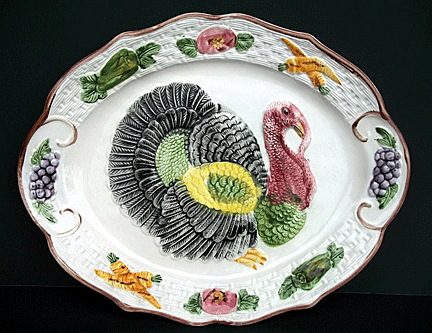 For
example, there’s a wild turkey platter painted and signed by
artist Mildred L. Broyles, depicting a standing, long-necked
bird eyeing a bug, valued at over $2,000. Another, signed by
Louise Gwinn called “Turkey Gobbler,” shows a bird in a woods
and sells for over $1,750.
For
example, there’s a wild turkey platter painted and signed by
artist Mildred L. Broyles, depicting a standing, long-necked
bird eyeing a bug, valued at over $2,000. Another, signed by
Louise Gwinn called “Turkey Gobbler,” shows a bird in a woods
and sells for over $1,750.