|
The
Influence of Ancient Greece
and Rome on the New Republic
by Bob Brooke
The Founding Fathers looked to ancient Greece and Rome to formulate the
government of the New Republic of the United States. Both George
Washington and Thomas Jefferson drew on classical concepts to establish
not only a system of government but also of civic values and
architectural design. Both ancient Greece and Rome laid the foundation
for democracy, from the Greek model and the rule of law based on the
Roman one.
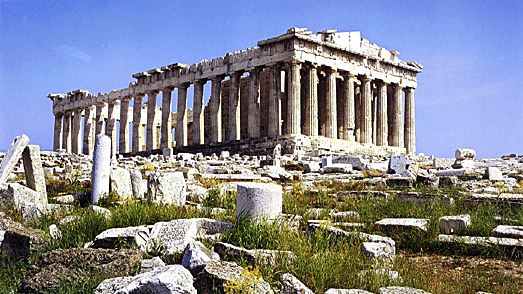
Both Jefferson and Washington adopted classical ideas to shape the legal
and political frameworks for the new government. The Roman Republic
served as a model for the U.S. government structure, emphasizing checks
and balances, civic duty, and the importance of a mixed government.
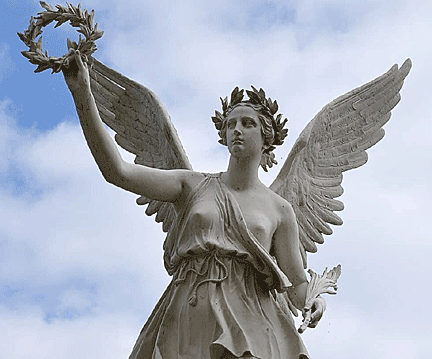 Early
American education emphasized the study of classical texts. This
curriculum aimed to instill civic virtues and knowledge of governance,
drawing from the works of ancient philosophers and historians. Early
American education emphasized the study of classical texts. This
curriculum aimed to instill civic virtues and knowledge of governance,
drawing from the works of ancient philosophers and historians.
Even those without formal education, like George Washington, were
familiar with classical cultures indicating the pervasive influence of
these ancient cultures in American society.
One of the most significant contributions of ancient Greece to the
United States government is the idea of democracy. In ancient Athens,
citizens had the right to participate in decision-making and had a say
in how their city-state was run. This principle of "rule by the people"
is similar to what is used in the United States, where citizens elect
representatives to make laws and govern on their behalf. While modern
democracy is much larger and more complex, its roots can be traced
back to the ancient Greeks.
The ancient Romans also played a vital role in shaping the United States
government. They introduced the concept of the separation of powers,
dividing their government into three branches: the executive, the
legislative, and the judicial. This system ensured a balance of power,
preventing any one person or group from becoming too powerful. The U.S.
government, with its President, Congress, and Supreme Court, adopted
this idea to ensure a fair and just system of governance.
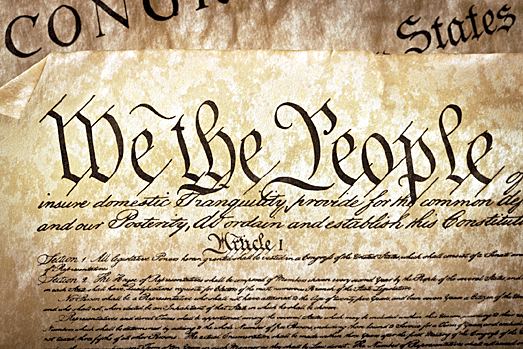
Both the Greeks and Romans believed in the importance of the rule of
law, where laws apply equally to all citizens, regardless of their
status or wealth. This concept laid the groundwork for the American
belief in justice and fairness under the law. Today, the United States
government follows this principle, ensuring that no one is above the law
and that justice prevails.
In ancient Rome, the Senate was a body of elected officials who made
important decisions for the empire. This idea influenced the creation of
the U.S. Congress, where representatives and senators are chosen by the
people to discuss and pass laws for the nation. Congress, like the Roman
Senate, acts as a crucial part of our legislative process.
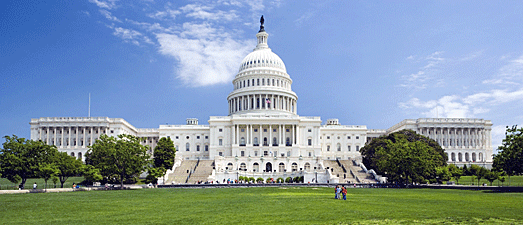
The Greek and Roman architectural styles have also influenced the design
of important buildings in the United States government. For example, the
U.S. Capitol building in Washington, D.C., draws inspiration from
ancient Greek and Roman temples. Additionally, the Statue of Liberty, a
symbol of freedom, is reminiscent of ancient Roman goddesses.
The Influence of Classical Heroes
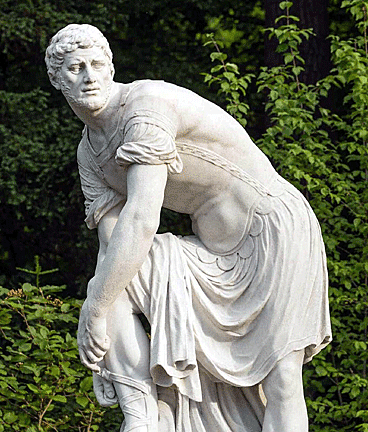 The
Founding Fathers admired and actively emulated classical figures such as
Cincinnatus, Cicero, and the Greek statesman Solon as paragons of virtue
and leadership. These classical stalwarts served as moral and practical
guides for their actions in the nascent American Republic. The
Founding Fathers admired and actively emulated classical figures such as
Cincinnatus, Cicero, and the Greek statesman Solon as paragons of virtue
and leadership. These classical stalwarts served as moral and practical
guides for their actions in the nascent American Republic.
Cincinnatus resonated deeply with George Washington, who, like the Roman
general, voluntarily relinquished his military command after the
Revolutionary War, reinforcing the ideal that leadership should be
exercised with restraint and in service to the public good.
Cicero's devotion to the Roman Republic and his denunciation of tyranny
shaped the philosophical underpinnings of many Founders, including John
Adams and Thomas Jefferson. Cicero's writings on natural law and the
intrinsic rights of individuals provided a foundational philosophy that
informed the Declaration of Independence.
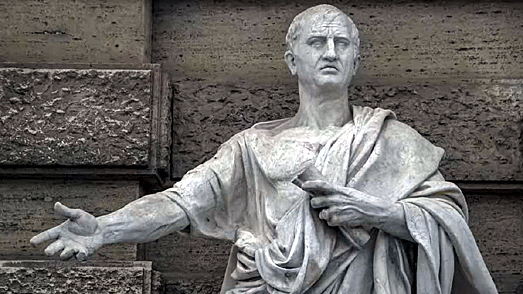
The concept of virtus, or civic virtue, underpinned the ethos
with which the Founders approached the creation of the new government.
They believed, as Cicero did, that the success of a republic depended
upon the moral character and active participation of its citizens.
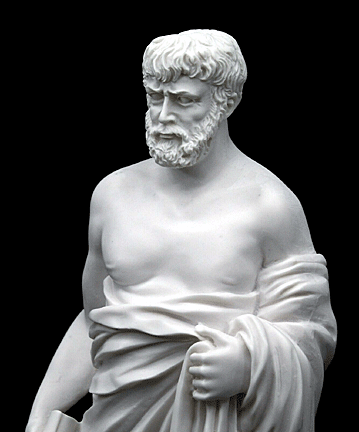 Solon,
the Athenian lawmaker credited with laying the foundations for democracy
in Athens, influenced the Founders with his reforms that promoted
economic fairness and legal equity. James Madison's reflections in The
Federalist Papers often draw parallels to Solon's balancing acts between
competing societal interests. Solon,
the Athenian lawmaker credited with laying the foundations for democracy
in Athens, influenced the Founders with his reforms that promoted
economic fairness and legal equity. James Madison's reflections in The
Federalist Papers often draw parallels to Solon's balancing acts between
competing societal interests.
These classical heroes provided a living blueprint for governance and
personal conduct. Through the emulation of Cincinnatus's humility,
Cicero's eloquence, and Solon's wisdom, the Founders combined the
ethical and civic virtues of antiquity with the enlightenment principles
of their time, creating a legacy that has transcended generations.
Architectural Inspirations from Antiquity
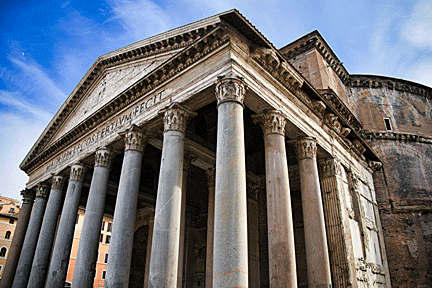 The
architectural choices made in the construction of key American buildings
draw heavily from ancient concepts. The
architectural choices made in the construction of key American buildings
draw heavily from ancient concepts.
The U.S. Capitol's design, inspired by the Roman Pantheon, embodies
classical elegance and endurance. The Capitol's interior features Doric
columns from the Temple of Apollo, Ionic columns from the Erechtheion,
and uniquely American Corinthian capitals blending native tobacco leaves
with classical acanthus.
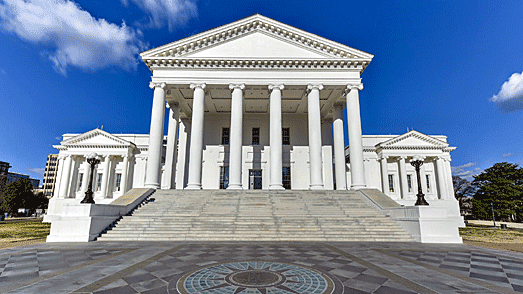
Thomas Jefferson's fascination with classical architecture is evident in
the Virginia State Capitol, inspired by the Maison Carrée in Nîmes,
France. This structure mirrors the grandeur and simplicity of a Roman
temple, conveying stability and republican virtue.
The layout of Washington, D.C., also bears the imprint of ancient
cities, with the Capitol on Capitol Hill evoking Rome's Capitoline Hill
and the National Mall drawing inspiration from the Roman Forum.
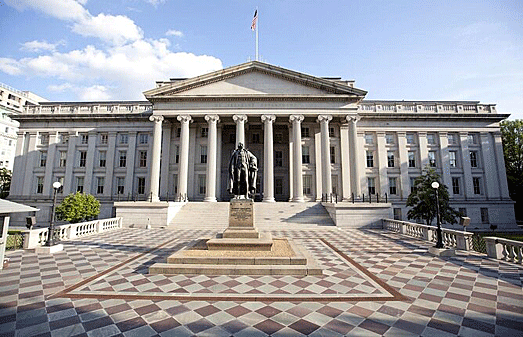
The city's collective classical aesthetic is visible in the Treasury
Building's Ionic columns, the Patent Office's Parthenon inspiration, and
the Lincoln Memorial's Doric colonnade. This conscious borrowing of a
language of power, endurance, and democratic ideals emphasizes the
Founders' belief in the enduring truths of the Greco-Roman world.
As the nation grew, classical influences in American architecture
evolved. The early Republic's embrace of Roman precedents gave way to
Greek Revival architecture, seen in the University of Virginia and
countless courthouses and statehouses across the country. This shift
reflects the evolving American ideals of democracy and enlightenment.

The architectural echoes of Greece and Rome across America's capital are
more than stylistic choices; they are a reminder of the values and
virtues the Founding Fathers held in the highest regard. Classical
architecture continues to speak to the timeless ideals of democracy,
liberty, and justice.
To read
more of my articles, please
visit
my Web site.
< Back
to Antiquities Archives Next
Article > |