The
Other Arts & Crafts Designer
by
Bob Brooke
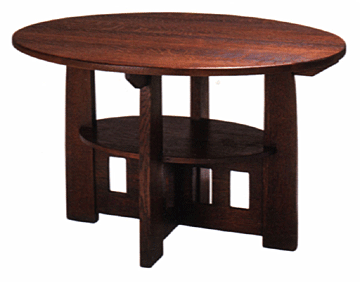 Charles Limbert made what you call “Mission” furniture in Grand Rapids
and Holland, Michigan. In fact, his furniture wasn’t constructed in the
Mission Oak style, which actually was a style of Arts and Crafts
furniture that developed just before the turn-of-the-20th century. This
wasn’t as much of a style as what manufacturers called furniture made of
oak that featured simple horizontal and vertical lines and flat panels
that accentuate the grain of the wood. It was supposed to emulate
furniture of the Spanish missions in California and Texas. What Charles
Limbert made was furniture in the pure Arts and Crafts style. Charles Limbert made what you call “Mission” furniture in Grand Rapids
and Holland, Michigan. In fact, his furniture wasn’t constructed in the
Mission Oak style, which actually was a style of Arts and Crafts
furniture that developed just before the turn-of-the-20th century. This
wasn’t as much of a style as what manufacturers called furniture made of
oak that featured simple horizontal and vertical lines and flat panels
that accentuate the grain of the wood. It was supposed to emulate
furniture of the Spanish missions in California and Texas. What Charles
Limbert made was furniture in the pure Arts and Crafts style.
The Arts and Crafts Movement in America originated in mid-19th-century
England where the teachings of John Ruskin and William Morris
popularized social reform. The movement began as a revolt against the
Industrial Revolution and the dehumanization of the workers being
replaced by machines. Americans learned about this movement through
Gustav Stickley's magazine The Craftsman. Hand craftsmanship and a
return to simplicity became hallmarks of the movement. These ideals
applied not only to the lifestyle of the follower, but also to furniture
and accessories in the home.
Hailed as the beginning of Modernism in the United States, Arts & Crafts
interiors were in direct contrast to the preceding Victorian period of
ornate decorative arts. Rectilinear forms of quartersawn oak replaced
ornately carved rosewood and mahogany Victorian furniture. Mortise and
tenon joints, butterfly keys, and the grain of the wood, itself, became
the ornamentation on Arts & Crafts pieces.
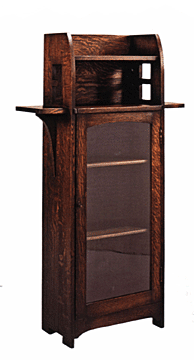 While Gustav Stickley is best known as the leader of Arts & Crafts
Movement in America, other designers also achieved recognition for their
contribution to Arts & Crafts design. One of them was Charles Limbert.
His company produced high quality Arts & Crafts furniture, but didn’t
attempt to influence consumers about the idealized harmony of the Arts &
Crafts lifestyle. While Gustav Stickley is best known as the leader of Arts & Crafts
Movement in America, other designers also achieved recognition for their
contribution to Arts & Crafts design. One of them was Charles Limbert.
His company produced high quality Arts & Crafts furniture, but didn’t
attempt to influence consumers about the idealized harmony of the Arts &
Crafts lifestyle.
In the early 1880s, Charles Linbert began his furniture manufacturing
career at the John A. Colby and Co.. in Chicago. He learned all sides of
the furniture business— design, production, and marketing. An 1889
partnership with Philip Klingman established the Limbert and Klingman
Chair in Grand Rapids, Michigan. Limbert and Klingman manufactured
period reproduction chairs for only two years. In 1894, Limbert formed
the C.P. Limbert and Company to produce Arts & Crafts furniture.
By 1906, the company had grown and moved to Holland, Michigan. Limbert
called his line of furniture "Holland Dutch Arts & Crafts," most likely
in reference to the local Dutch population.
Limbert's early furniture shows influences ranging from Japanese to
Gothic. Some of his early china cabinets and bookcases have doors with
stained glass in an Art Nouveau style.
His peak of design achievement came during 1904 to 1906 when he
introduced many of his cut-out designs. Many of his de-signs were
internationally inspired by the Vienna Secessionist School and designers
such as Scotsman Charles Rennie Mackintosh and Austrian Josef Hoffmann.
Limbert employed designers such as Hungarian architect Paul Horti and
father and son Austrian designers, Louis and William J. Gohlke.
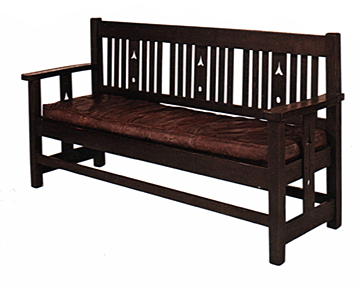 Limbert promoted his furniture as being "essentially the result of hand
labor, with machinery being used where it can be employed to the
advantage of the finished article." Like Stickley, he didn’t let
machinery control production and emphasized the contribution of skilled
craftsmen in his furniture promotions. Limbert promoted his furniture as being "essentially the result of hand
labor, with machinery being used where it can be employed to the
advantage of the finished article." Like Stickley, he didn’t let
machinery control production and emphasized the contribution of skilled
craftsmen in his furniture promotions.
He constructed his furniture of quartersawn white oak, with
well-executed doweled joints, keyed tenons and splined tabletops. Long,
tapering corbels under arms characterize Limbert chairs. Unfortunately,
Limbert didn’t extend his wood working quality to the hardware used on
his pieces, most of which came from the Grand Rapids Brass Company.
Compared with Stickley's work, Limbert's designs were typically less
severe and more visually interesting, usually achieved through the use
of cut-outs and other elements inspired by the as English Arts & Crafts
Movement and Dutch folk furniture.
His pieces were among the original furnishings of the Old Faithful Inn
in Yellowstone National Park. Today, several wash stands remain in the
Old House section of the Inn.
To read
more of my articles, please
visit
my Web site.
<
Back to Antiques Articles
Next Article >
|