|
U.S. Bank Notes
Reveal the
Country's Early History
by
Bob Brooke
American banknotes have
not always been green-In the mid-19th century, banknotes contained a
rainbow of colors. By examining these paper artifacts, Collectors can
take a tour of America circa 1800.
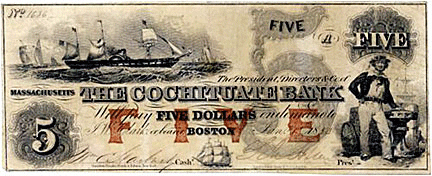
Prior to the Civil War. the U.S. government didn't regularly issue paper
money. But people still needed to use some form of currency, so banks
issued their own paper money—bank notes.
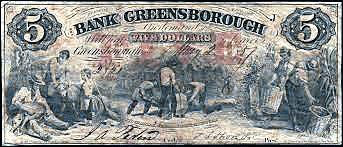
Many types of notes circulated during this era, known as the golden age
of U.S. currency, which generally began in the late 18th century and
lasted until the Civil War. The most common type of note, the "demand
note," entitled the bearer to a certain monetary amount. Individuals
would deposit something of value in the bank (usually herd current
stock), and the bank would issue to the individual on-demand notes that
he or she could use as a vehicle of exchange to purchase items from a
merchant who could then redeem the note with the bank, that "on demand"
would exchange the bank for gold or silver coins issued by the federal
government.
A bank's capital, which often appears on the banknote, (capital
$1,000,000), guaranteed the value of these notes, and for this reason,
two officials often signed each note to ensure that a greater amount in
banknotes was nut issued than the bank could cover. Private hanks and
public banks, which obtained a charter to operate, and savings banks,
which operated under a different set of rules, all issued the demand
note. Some demand noted contained a space in which a bank official wrote
a payee's name and thus allowed a bank to specify the identity of the
hearer, who would endorse the note by signing its often blank reverse as
one would endorse a modern cheek. Other types of notes circulated as
well. Post notes worked like bonds and were redeemable only after a
predetermined time noted on the bill (e.g. "redeemable after six
months").
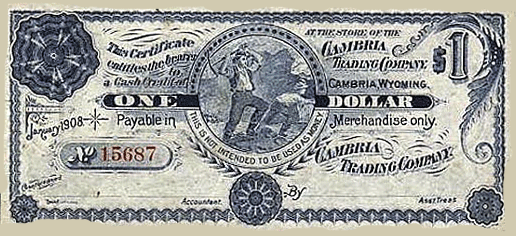
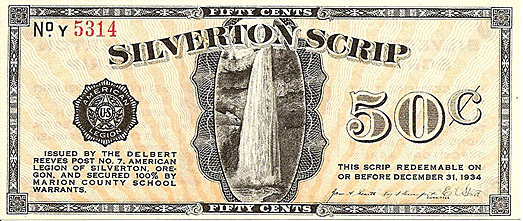
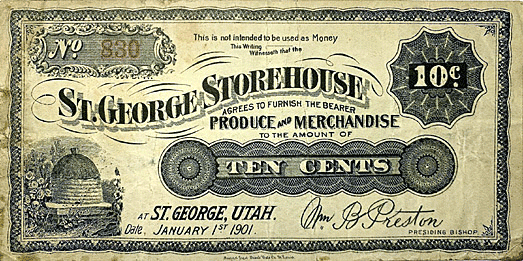
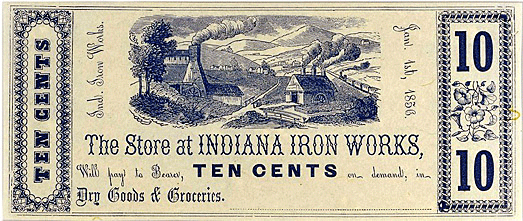
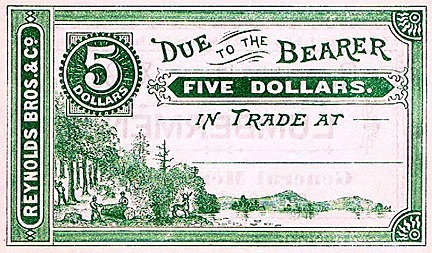
Private merchants also issued notes, sometimes referred to as scrip,
which they used to pay employees. Some laborers were paid only in scrip,
which was generally redeemable only at company 'stores. This often led
to the economic enslavement of laborers who "owed their soul to the
company store." Railroads, shipping lines and many other type, of
merchants issued notes to their employees.
While the bank note system worked, poor or dubious business practices
threatened the integrity of the private and state banking system that
ran amok in the first half of the 19th century.
Most of the time, banks were honest. But stories of fraud were rampant.
banks that issued more money than their capital guaranteed and banks
with a phantom capital, or no money to guarantee their notes.
This led to the distrust of unfamiliar hanks, and as a result, the notes
did not work well for inter-state banking. A merchant in one state
wouldn’t honor a bank note from an unfamiliar bank in another.
With so many different bank notes circulating, the proliferation of
fakes or counterfeit notes was inevitable. The sheer number of issuers
and varieties of notes issued—more than 1,600 banks in 34 states
collectively issued more than 10,000 varieties—provided the hungry
counterfeiter with a virtual smorgasbord.
The word counterfeit refers to an illegally replicated note. Some
genuine notes had their denominations altered; consequently, the
alteration raised the value of the note, hence the name "raised note." A
variation on this theme, the "altered" note also appeared. An altered
note was a genuine note altered to look like another bank's product. The
more artistically inclined produced original designs and added a
legitimate hank's name on the notes, thus creating a spurious note.
 In
fact, so many counterfeit notes circulated—some 55.000 varieties—that
bank officials began to stamp or handwrote the word “counterfeit” across
the surface of the note. In
fact, so many counterfeit notes circulated—some 55.000 varieties—that
bank officials began to stamp or handwrote the word “counterfeit” across
the surface of the note.
During the Civil War, the U.S.Congress took action to end private
issuance of banknotes. Congress passed legislation that forbade the
private issuance of currency, and the federal government began issuing
its own notes. Banks could still issue currency bearing their own name,
but to do so, they needed to obtain a charter from the federal
government, which entitled them to issue notes, known as National Bank
Notes, supplied by the federal government.
The new notes led to the modern association of money with the color
green. This relative lack of variety could make the counterfeiter's job
much harder, though, and the number of attempted counterfeits dwindled.
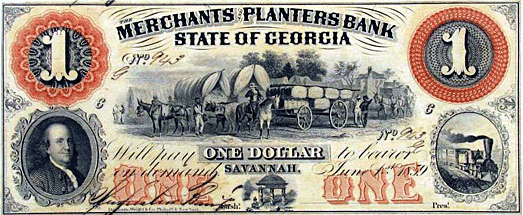
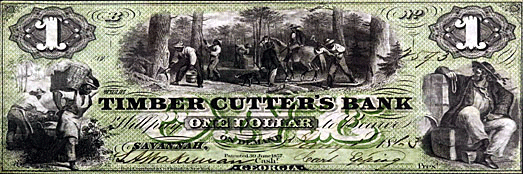
The most interesting aspect of obsolete banknotes is the detailed and
often colorful vignettes they contain, which collectively offer a
lithographic history of American culture. Each bank note told a story. A
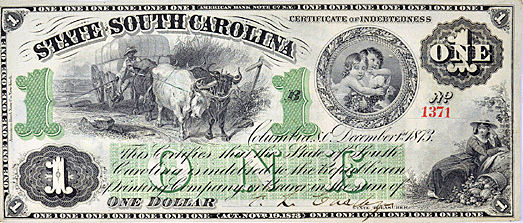
$1 note from The Merchants and Planters Bank f Savannah. Ga., for
examplel, contained the image of a covered wagon. When the note was
issued in the 1830s, the covered wagon would have been the preeminent
mode of transportation taken by settlers traveling to the Western
territories.
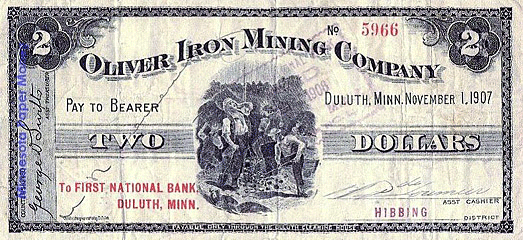
Scrip from the Delaware Mine on Michigan's Upper Peninsula features the
image or a copper finer wielding a pickax. A $5 note from the. Bank of
the Commonwealth in Richmond, 'a., contain, the image of planters
standing next to the barrel of tobacco—one of the crops that drove
Virginia's economy in the antebellum era. Moments frozen in time, dense
images offer the closest thing possible to a photograph of 19th century
life.
<
Back to Collecting Archives
Next Article >
|