Guest Blog
Fabergé Eggs
Posted by Gill Jones on
Antiques.co.uk
Once upon a time in Russia (and I’ve always wanted to say that), there
was a jeweler/artist/goldsmith working for the Russian Imperial Court.
He would go on to create the world-famous Faberge egg, named after
himself of course. Yes, Faberge eggs are for the rich. All his eggs were
and still are decorated with the finest jewels and the most precious
objects imaginable. They are symbolic of a dynastic and passionate world
for which there is no equivalent today. They embody the world from which
they came.
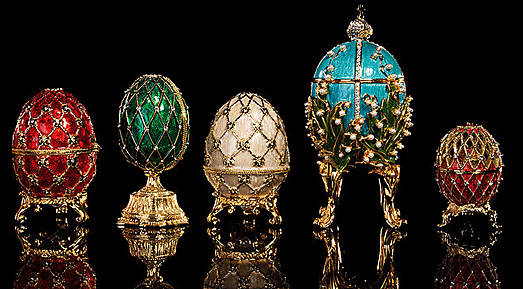
Faberge himself was born in the middle of the 19th century and traveled
the world before settling down to a goldsmith course in France, England
and Germany. He learnt his craft well, and his exquisite eggs were
representative of his talent and dedication to even the minutest of
details.
So, what can you expect from a Faberge egg?
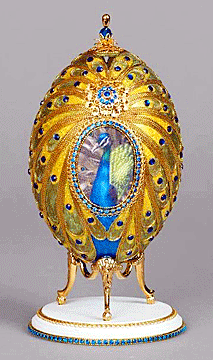 Like
a Kinder egg, but oh-so-much better than a Kinder egg, a Faberge egg
often contained a surprise, and more often than not that surprise was
even better than its container—if that’s even possible. It could be a
clockwork toy or a miniature train, and always bejeweled to the Nth
degree like the egg it sat in. Yes, they were commissioned by the
Russian Royal family and they passed them on to each other as presents,
and apparently, there were only ever 50 made and only 43 survive. So,
getting your hands on an original is not only going to be a rare
occurrence, it’ll also be very, VERY expensive. Like
a Kinder egg, but oh-so-much better than a Kinder egg, a Faberge egg
often contained a surprise, and more often than not that surprise was
even better than its container—if that’s even possible. It could be a
clockwork toy or a miniature train, and always bejeweled to the Nth
degree like the egg it sat in. Yes, they were commissioned by the
Russian Royal family and they passed them on to each other as presents,
and apparently, there were only ever 50 made and only 43 survive. So,
getting your hands on an original is not only going to be a rare
occurrence, it’ll also be very, VERY expensive.
But, what about any new Faberge eggs, because the Romanov family no
longer exists, so it’s not as if they can commission any new ones, is
it?
No, they can’t, but the Faberge brand and its current owners create new
eggs and call them Imperial Class eggs, making them the first since the
early part of the 20th century.
Faberge was once owned by Unilever, before being sold on to Pallinghurst
Resources, and they then relaunched back in 2009 with Faberge’s
grandchildren at the helm. In 2012 they were bought by Gemfields, which
is just as well, as they own previous stone mines and know an awful lot
about gems. Of course, Pallinghurst still retains a stake in the
company.
So, what happened to those original 43 Faberge
eggs?
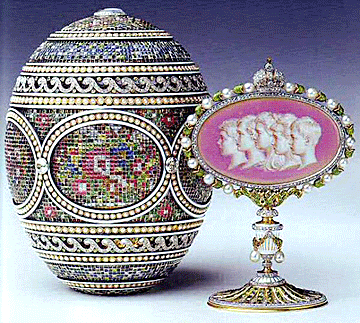 As
you can imagine they are as rare as an original Van Gogh, and they are
THE ultimate find for antique lovers the world over. Apparently,
the Queen Elizabeth owns at least 3 of the Imperial Eggs which form part
of the Royal Collection. One of the most famous of the three owned is
the Mosaic egg which was designed exclusively for Tsarina Alexandra. And
yes, there was a secret gift inside, a miniature medallion with pictures
of the children, it was snapped up by a clever King George V in London
for the princely sum of £250. As
you can imagine they are as rare as an original Van Gogh, and they are
THE ultimate find for antique lovers the world over. Apparently,
the Queen Elizabeth owns at least 3 of the Imperial Eggs which form part
of the Royal Collection. One of the most famous of the three owned is
the Mosaic egg which was designed exclusively for Tsarina Alexandra. And
yes, there was a secret gift inside, a miniature medallion with pictures
of the children, it was snapped up by a clever King George V in London
for the princely sum of £250.
The rest are apparently still in Russia with an oil and gas tycoon
buying 9 of them for $100 million, and 10 being bought by the
Kremlin Museum in Moscow. Others are scattered all over the world,
mostly in American museums.
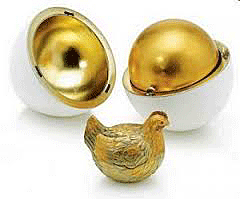 The
oldest and first Faberge egg was the Hen Egg. Simple, with white enamel,
but inside was a yolk made from solid gold with a golden hen sitting
within the yolk. And yes, there were more gifts inside the hen, two in
fact. One was an exquisitely identical miniature of the Royal Crown and
the second was an egg pendant, with a tiny ruby egg. Unfortunately,
these gifts went missing. The
oldest and first Faberge egg was the Hen Egg. Simple, with white enamel,
but inside was a yolk made from solid gold with a golden hen sitting
within the yolk. And yes, there were more gifts inside the hen, two in
fact. One was an exquisitely identical miniature of the Royal Crown and
the second was an egg pendant, with a tiny ruby egg. Unfortunately,
these gifts went missing.
The Hen Egg was made in the latter half of the 19th century and
commissioned by Alexander III, and of course it’s
 now
owned by that very same, very lucky and very rich Russian oil and gas
tycoon mentioned earlier. now
owned by that very same, very lucky and very rich Russian oil and gas
tycoon mentioned earlier.
Unfortunately, here on
www.antique.co.uk
we do not have any of the 43 remaining Faberge eggs on sale, if
we did, they wouldn’t be there very long. However, we do have an antique
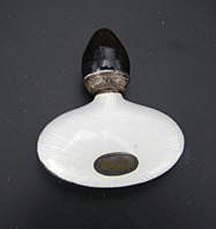
‘Faberge’ style egg fob/pendant from the mid-20th century made from 18ct
gold. If you fancy a little of the Faberge magic, it wouldn’t be a bad
place to start.
<
Back
to Guest Blog Archives
Next Guest Blog > |